
Going Long With Jennifer Brunelli
Jennifer Brunelli on Why What You Eat Is Costing You More Than You Think
Most open water swimmers have a training plan. They track their yardage. They obsess over their gear. A lot of them have worked with coaches on technique. Very few of them have ever sat down with a registered sports dietician and looked seriously at what they are putting in their body before, during, and after a long swim.
Jennifer Brunelli has spent her entire career thinking about exactly that. She is a seven-time All-American swimmer, a University of South Carolina Hall of Famer, and has the credentials to back up what she knows. She served as the Carolina Panthers team dietician for seven seasons. She has been embedded with NASCAR teams and drivers for over a decade. She knows what elite performance nutrition looks like at the highest levels, and this November she is bringing that to the open water community at Beyond the Breakers.
I sat down with Jennifer for an episode of Going Long, our interview series featuring the speakers you will see on the stage at Beyond the Breakers in November. What came out of our conversation changed how I think about fueling. I think it will do the same for you.
Who Is Jennifer Brunelli?

Jennifer Brunelli is a registered dietician and performance nutrition coach at therdpro.com. She swam at the University of South Carolina, where she earned seven All-American honors and was inducted into the Hall of Fame. She credits the jump from good to great in her own swimming directly to understanding how to fuel her body properly.
After her competitive career, she channeled that experience into building a sports nutrition practice that now spans professional sports and endurance athletics. She spent seven seasons as the sports dietician for the Carolina Panthers in the NFL and has worked across NASCAR with multiple teams and drivers for over ten years. She now works with athletes at every level, from professionals to age group swimmers who just want to feel better and go longer.
Her philosophy is simple. The science of sports nutrition only matters if the athlete can actually use it. So she makes it practical, individualized, and realistic.
The Jump That Changed Everything
I asked Jennifer for her 30-second elevator pitch and what she gave me was better than that. She described going from a decent SEC swimmer to second in the nation at the NCAA Championships. The variable that changed was not her technique or her training volume. It was food.
"My elevator pitch is I've experienced what it's like to be that athlete, especially in the water, and how much of an impact food can have," she said. "My passion is to take the science of sports nutrition, make it practical, individualize it, make it realistic, so an athlete can train harder, recover faster, and generally just enjoy the sport longer."
That last part is what hooked me. Enjoy the sport longer. For a community of masters swimmers, open water athletes, and people in their 30s, 40s, and 50s who are still chasing big goals, that framing matters. This is not just about performance on race day. It is about sustainability over years.
The Biggest Mistake Open Water Swimmers Make
I asked Jennifer what she sees most often in athletes who come to her before they have worked with a sports dietician. Her answer was direct.

Nutrition is not something you add to your training. It is one of the reasons your training works at all. If you have not practiced your fueling in training, it is not going to work on race day.
"If you haven't practiced what it is you want to do in a competition setting, it's very unlikely to be successful in a competition setting," she said. "You're combining endurance, unknown environments, the logistics of travel, the potential restriction of feeding depending on what's going on in the water. Whether it's cold or hot, you have to know how you as an individual are going to respond."
She put it in a way that immediately made sense to me as a swim coach. A coach does not train you for the 200 butterfly all season and then pull you aside two days before the meet and tell you that you are swimming the 50 free, 50 back, and 50 breast instead. So why would you go into an open water swim having never practiced the fueling strategy you are planning to use? The race is not the time to find out whether your gut handles glucose or fructose better.
Train the Gut Like You Train the Muscles
One of the phrases Jennifer used that I had never heard before is this: you have to train the gut just like you would train the muscles. It sounds obvious when she says it. But most swimmers have never thought about it that way.
What she means is that the gut responds to repeated exposure. It adapts. If you use a certain fuel source consistently in training, your GI system learns how to process it during effort. If you show up to a channel swim with a product you grabbed at the expo the day before, you are asking your gut to do something it has never done before under the hardest conditions it will ever face.
"We have to train the gut just like we would train the muscles," she said. "If we're not giving our body an opportunity to know what certain things feel like, you can't just replicate what somebody else is doing."
As a coach I do the same thing. I tell my athletes we do long training swims early in a program specifically so they can figure out what they want to eat, how much they can tolerate, and how their body responds. Then we adjust. The trial and error of fueling has to happen in training, not on the big day.
Carbs Are Not Carbs and Sugar Is Not Sugar
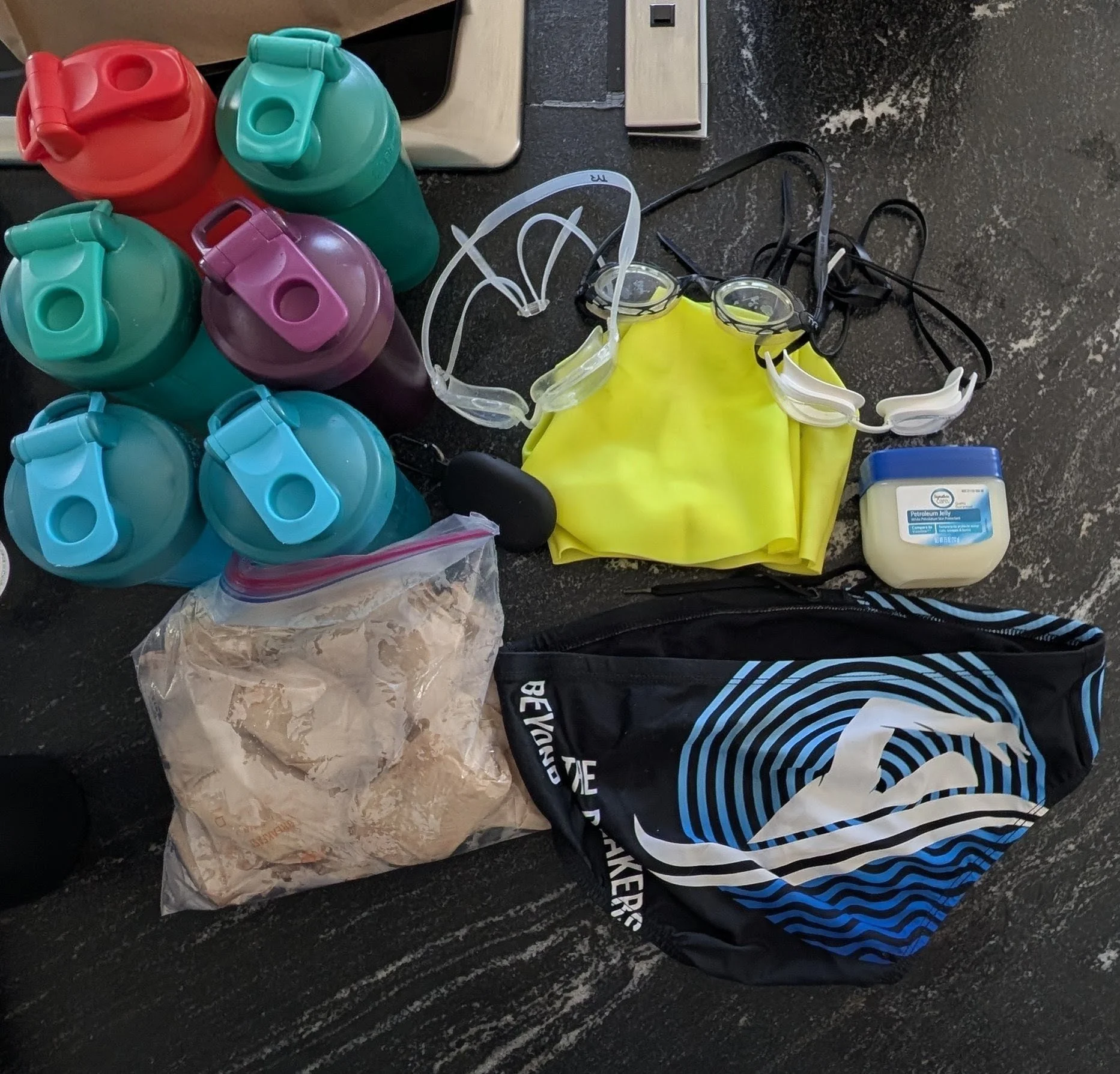
This is the part of the conversation that gave me the most to think about. Jennifer broke down something that sounds obvious but that most swimmers have never actually applied: different types of carbohydrates behave very differently in the gut.
If you flip over any energy product you use in training or racing, you will see fructose, glucose, maltodextrin, or some combination of the three. Every athlete's GI system responds differently to each of these. Artificial sweeteners added for flavor can also be high-impact triggers for GI distress.
"If a product doesn't work for you, we need to understand why," Jennifer said. "Let's look at what's in it and determine the most likely reason it was unsuccessful. So let's not go try another product that has exactly the same thing in it."
That is a different level of troubleshooting than most of us do. If a gel makes you feel sick, most swimmers stop using that brand and grab a different one. Jennifer would look at the ingredients and help you figure out whether it was the type of sugar, the sweetener, or the concentration. Then you would choose the next product based on that information, not by guessing.
Why You Cannot Just Copy What the Pros DO
I see this constantly as a coach and Jennifer put it better than I have ever been able to. The open water and triathlon community is full of athletes who look at what elite professionals eat and train and try to replicate it. It almost never works.
"That age group swimmer cannot mimic what a professional swimmer is doing," she said. "The base that's been built for that pro swimmer, the experience, the repetition, they're asking very different things of their bodies and their bodies are coming from very different places."
A professional swimmer in their 20s whose entire life is training and recovery is operating in a completely different physiological environment than a 45-year-old with a job, a family, and eight hours of training per week. The caloric demands are different. The recovery windows are different. The stress load on the body is different. What works for one will not work for the other and in some cases will actively make things worse.
This is why Jennifer approaches every athlete the same way regardless of their level. She starts by learning where that person is, not where the best in the sport is.
What Her BTB Presentation Covers
Jennifer's session at Beyond the Breakers 2026 is going to be one of the most practically useful presentations on stage. Here is what she told me she plans to cover.
She wants to go deep on fueling during the swim specifically because that is where individualization matters most and where most swimmers are operating with the least amount of real information. She will walk through how different types of sugars and carbohydrates affect the gut and give attendees concrete tools to go back to their own training and apply.
She is also going to spend significant time on hydration and how fluids, electrolytes, and carbohydrates work together as a system. The three do not operate independently. The right fluid intake in cold water looks very different from the right fluid intake in warm water, not just in volume but in composition.
Jennifer uses individualized sweat analysis to determine exactly how much fluid and sodium an athlete loses per hour during effort. That number is different for every swimmer and it directly determines how you replace what you lose.
"Every athlete does not lose the same," she said. "So I offer sweat tests where we can say this is the ounces of fluid per hour that you're losing and this is the milligrams of sodium per hour that you're losing. That dictates how we replace."
I get emails from my athletes asking how many electrolytes they should take in. I always have to tell them honestly that I do not know, because the answer is different for every person. After November, a lot more of us will actually have that number.
Who Needs to Be in the Room
Jennifer said it simply: anybody who wants to be better than they were yesterday. And she meant it. This is not a session for elite athletes only. It is for newer swimmers who have never thought seriously about fueling. It is for experienced athletes who have a system that kind of works and want to know if it could be significantly better. It is for coaches who want to understand the ingredients behind the products their athletes are using.
"Science only matters if the athlete can actually use it," she said. "I can give athletes all the science in the world. But if it's not something you know how to translate into practice, it does nothing."
That is the whole point of her approach and it is the whole point of Beyond the Breakers. Knowledge that you can take home and actually apply.