
Going Long With Bob Fernald
What Every Open Water Swimmer Should Know About Race Safety
When Bob Fernald crossed the English Channel at 47, Manhattan at 48, and Catalina at 49, he had already discovered something most swimmers never realize. The sport that drew him in wasn't just about personal accomplishment. It was about building the infrastructure that would let others chase their own dreams.
Today, Bob works as a race director and US certified safety official, helping organize events across New England. He's one of the most knowledgeable people in the region when it comes to how open water swimming events actually work—the permits, the protocols, the decisions that happen behind the scenes that most swimmers never see.
That perspective makes him uniquely positioned to answer a question a lot of newer swimmers have: Why do events have cutoffs? Why are there pre-qualifiers? And why do race directors make the decisions they do?
Coming to Open Water Later in Life
Bob's path to open water swimming wasn't conventional. He didn't grow up as a swimmer. He came to the sport as an adult, and even then, it wasn't his first choice.

Photo Credit Helen Cogan Photography
"I did a couple of triathlons out of peer pressure and really didn't like the swim," Bob explained during our conversation. "Eventually I got away from the sport entirely. One winter I went back to swimming after probably four or five years off because that's how much I didn't like to swim."
But something changed when he returned to the water. After nearly five years away, he noticed he was swimming with remarkable efficiency. That discovery prompted him to figure out what had changed, and the answer came down to one fundamental principle: body position.
"I solved pretty much the number one problem swimmers have in the water, which is body position," he said. "I found that through my journey through Pilates. I tell people Pilates doesn't make everyone a good swimmer, but good attention and control and awareness of the body is what did it for me."
This realization—that efficiency matters more than raw power—became the foundation of how Bob approaches both his own swimming and how he coaches others. It's also why he's been so effective at helping swimmers progress beyond their plateaus.
The Single Biggest Mistake First-Time Open Water Swimmers Make
If you're thinking about doing your first open water race, Bob has seen the mistake play out countless times. It's so common that he considers it the number one issue holding swimmers back from a successful transition to open water.
"Understanding where you are with your swimming and your true comfort level with what you're going into," Bob said. "People look at an event and they'll look at the distance and they'll say, 'That's manageable. I can swim three miles in a pool. What's a mile in the open water?' and try to just walk from the pool into the open water."
The gap between pool swimming and open water swimming is bigger than most swimmers expect. In a pool, you have the black line guiding you. The water conditions are relatively consistent. You can touch the bottom if you need to. You know exactly how far you need to go because the pool is a fixed distance.
Open water is fundamentally different. You can't see the bottom. You need to know how to sight properly. You need to understand navigation, currents, and the dangers unique to open water environments. You need experience, and that experience can't be rushed.
"Once you can't see the bottom, even the best swimmers in the world can freak out," Craig noted during the conversation. "If you don't know about sighting, if you don't know how to navigate, if you don't know the dangers of open water swimming, it can go south pretty quickly."
Bob's recommendation is straightforward: Get in the water with your local open water community before you sign up for a race. Most communities are welcoming and eager to help newcomers prepare.
Understanding Pre-Qualifiers: They're Not About Being Elitist
One of the biggest misconceptions Bob encounters is the idea that pre-qualifiers are designed to keep slower swimmers out of events. That's not it at all.
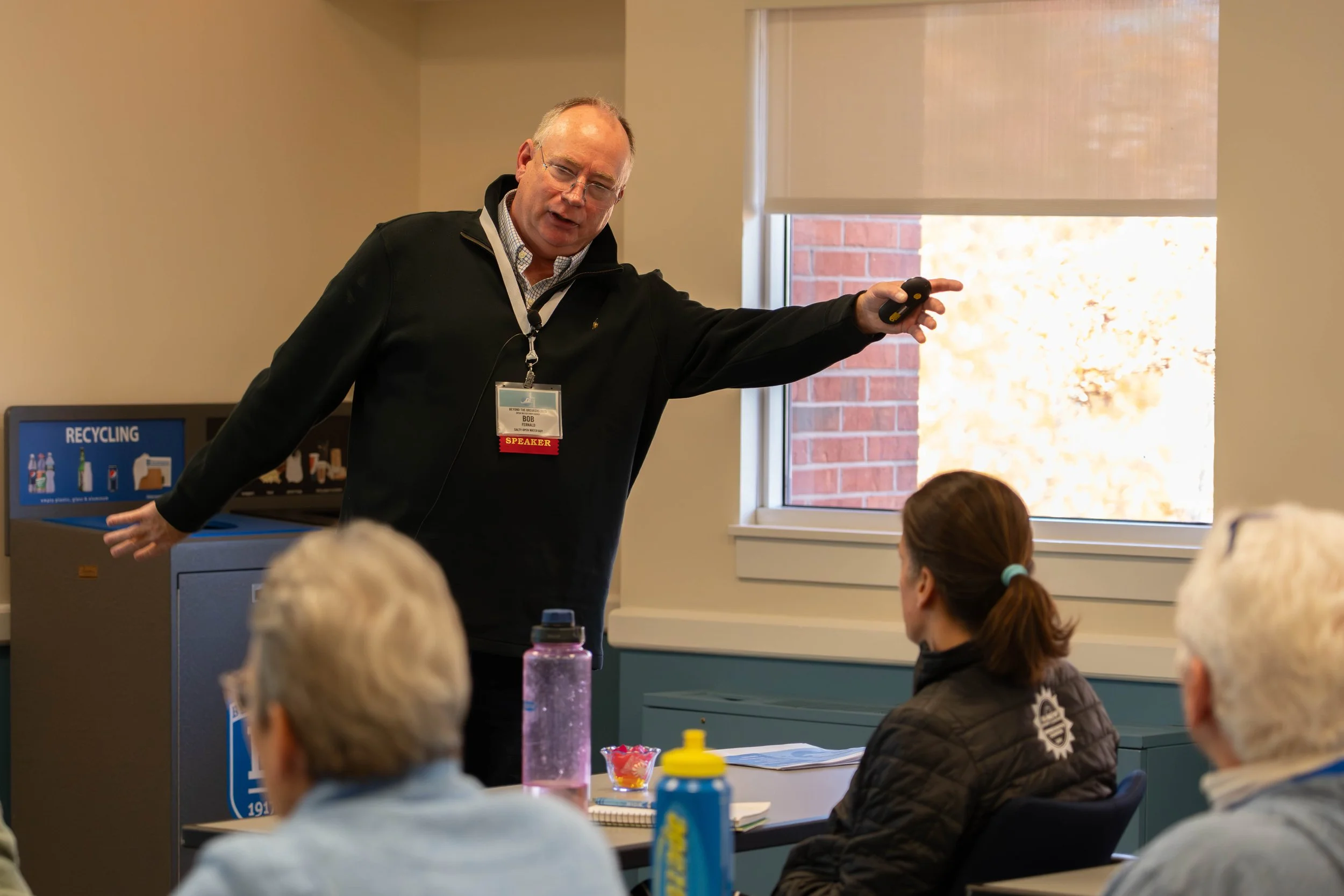
Photo Credit Helen Cogan Photography
Pre-qualifiers exist for safety and logistics. Multiple factors influence what those qualifiers look like, and understanding them helps swimmers make smarter decisions about which events are right for them.
The event's location matters significantly. Different bodies of water have different characteristics. Bob mentioned the Nubble Lighthouse swim, which involves navigating between an island and a peninsula through a very narrow channel. At certain tide levels, that channel becomes impassable. If swimmers can't navigate it at the halfway point within a certain time window, they won't make it through the event at all.
Water temperature and experience with different thermal conditions also play a role. The difference between swimming in a wetsuit and swimming without one is enormous. Switching from one to the other requires experience and adaptation.
"We ask for background information on swimmers if they'd like to provide it and reach out to people to let them know about our event, specifically those who are wanting to swim without a wet suit," Bob explained. "Water temperatures and experience also play into the factor for prerequisites."
The Real Story Behind Time Cutoffs
If pre-qualifiers create confusion, time cutoffs generate genuine frustration. Swimmers see a cutoff time and interpret it as the race director saying, "We only want fast people here." That's a fundamental misunderstanding of what cutoffs actually do.
Time cutoffs are almost always set by factors completely outside the race director's control. They're determined by permitting agencies—the Coast Guard, local marine patrol, fire departments, police departments, and harbor operations. These agencies approve the event based on specific conditions, and those conditions include how long the safety infrastructure can remain in place.
"We have an event command that's allowed to monitor the operation for four hours," Bob said about one of the events he works with. "When the event command goes away, the swim goes away. That's what we signed up for. That's why there's a time limit on that one."
The Boston Marathon provides a useful analogy. Eventually, the city has to open the roads back up for normal traffic. In the same way, waterways have permitting restrictions. The area where swimmers finish—whether it's a state park, harbor, or marina—can only accommodate a certain amount of use for a certain amount of time.
Tidal changes introduce additional complexity. In tidal flow areas, if you're not with the tide, you might not finish at all. Weather patterns also matter. Certain times of year bring predictable conditions that event coordinators try to avoid. On the West Coast, for example, trade winds create challenges that force event planning around specific windows.
"We don't choose cutoffs based on the speed of a swimmer," Bob emphasized. "If I had my way and if it was possible, we would have every swimmer swim the Nubble Light without exception. It's just not possible. A lot of these conditions are circumstances beyond the event coordinators and volunteers' control."
What Goes Into a Proper Safety Plan

Most swimmers never think about the machinery behind an event. They show up, swim, and go home. But the safety infrastructure supporting that swim is extensive and involves multiple organizations working in coordination.
The Nubble Lighthouse is one of the events Bob is involved with, and it serves as a good example of how a proper safety plan develops. When Bob Reed, the original founder, decided to create the event, he sat down with representatives from the police department, fire department, ambulance service, York Village Fire Department, York Harbor Operations (where lifeguards report), and local marine patrol.
"Everybody started to say these are the elements of a safety plan. These are the elements of an approval plan," Bob recalled. "I became involved in that process and now I use those as a template basically for every event I work on because they're all fundamentally the same and have to have the same considerations."
The key elements of a solid safety plan include clear communication protocols, backup communication plans, boat equipment requirements, contingency plans, medical protocols, and clear procedures for how swimmers communicate distress and how boats respond.
Communication deserves special attention because it's the backbone of everything else. Radio coverage needs to be mapped. Communication channels need to be specified. Boat captains need to understand how to communicate with swimmers, and swimmers need to know the international distress signal (hand waving over the head).
Medical protocols also require serious attention. Bob explained how event volunteers work with medical professionals to develop flowcharts that help lay people recognize symptoms of conditions like cold water immersion and pulmonary edema.
"We don't expect them to be medical experts, but they can if they hear somebody that's, you know, coughing, check if there's any rattling for pulmonary edema and things like that," Bob said. "We spend the time to go over that with the boat captains. If someone is in distress and the captain can make a decision and go straight to channel 16 to the Coast Guard, that's the best path."
The Rule That Nobody Thinks About
One small but revealing story Bob shared shows how continuous improvement actually works in event organization. Early on, the Nubble Light team thought it was a good idea to identify swimmers by race number and age. They'd write the race number on one arm and the age on the other.
The problem became clear quickly. When a volunteer pulled a swimmer out of the water, they'd radio back to command central: "We just pulled swimmer 32 out of the water." Command central would check the finish line, and sure enough, swimmer 32 was already checked in. How many swimmers are 32 years old? Probably a lot.
"So guess what we don't do anymore? We don't put numbers on the swimmer," Bob said with a laugh. It's a small example, but it illustrates something important: event safety and logistics are constantly evolving. Organizers learn from what doesn't work and improve the next year.
The Most Important Rule
At the end of the day, Bob says there's one fundamental principle that governs everything: "The number of asses that come out of the water has to equal the number of asses that went into the water."
How they get out, whether they set a personal record, whether the event runs smoothly—those are all continuous improvements. But getting everyone out safely is the foundation that everything else builds on.
This is why event directors ask for pre-qualifiers. This is why time cutoffs exist. This is why there are strict communication protocols and extensive safety plans. It's not about being exclusive or elitist. It's about making sure that every swimmer who enters the water comes back out.
What Bob Sees When He Goes to Events
As someone who's both an elite swimmer and an event coordinator, Bob has a unique vantage point. When he shows up to an event as a participant, what's the first thing he looks for?
"The minimum thing I look for is, is it safe?" he said. "You know, is it fancy? I don't care about as a swimmer."
If he sees issues with the safety plan or event organization, he doesn't challenge the director during the event. Instead, he reaches out afterward with constructive feedback during pre-season planning. That's how the sport improves. Veterans help newcomers. People who've learned hard lessons share that knowledge to make the sport safer for everyone.
The Real Issue Holding Swimmers Back
Beyond the logistics of events, Bob has noticed a pattern in what prevents swimmers from progressing to the next level. It comes down to how swimmers respond when conditions get tough.
"When somebody says you need to start turning your paddles faster because of said current or you're getting too close to the boat, the most immediate reaction is to frantically move at a faster repetition," Bob explained. "That takes people into a fighting the water mode as opposed to trying to focus on working with it when you need to change gears."
Swimmers turn on the "afterburners" and forget the basics. They abandon body position, which is the foundation of everything. They lose efficiency while trying to gain speed. It's a natural response—that fight-or-flight reaction that served us well on land isn't the right approach in the water.
This is what Bob and Charlotte will be exploring at Beyond the Breakers 2026. They're not just talking theory. They're teaching specific exercises and techniques that help swimmers feel what good core engagement and body position actually mean on land, so they can translate that feeling into the water.
Beyond the Breakers 2026
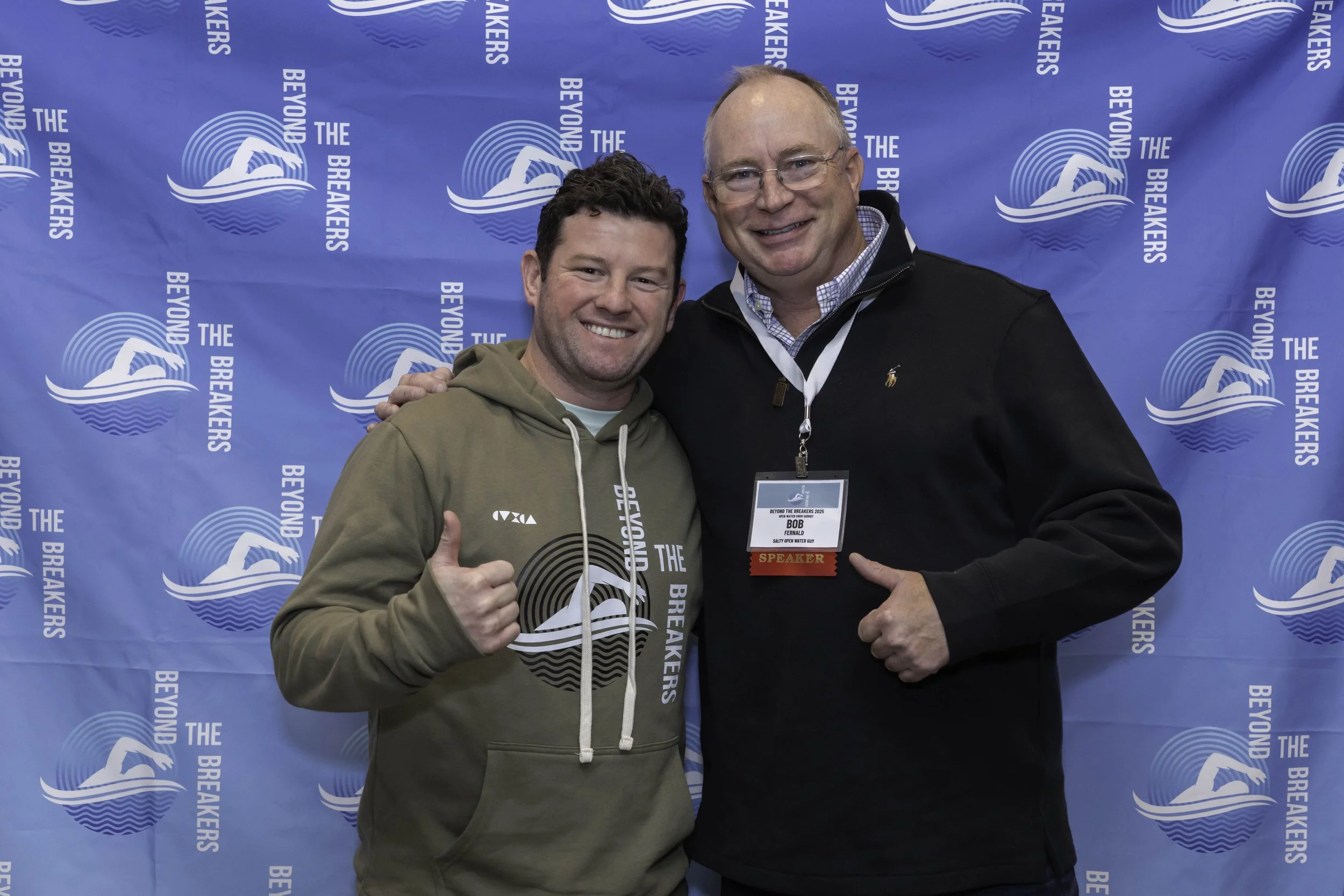
Photo Credit Helen Cogan Photography
Bob is returning for his third year speaking at Beyond the Breakers. His presentation with Charlotte is designed to be accessible to all levels. For swimmers still figuring things out, mastering body position will accelerate your learning. For experienced swimmers looking for that competitive edge, understanding how to align your vessel through the water might be exactly what's been missing.
The Takeaway
Bob Fernald's story and perspective offers something valuable to every open water swimmer, whether you're a first-timer or someone chasing a world record. Events aren't designed to exclude you. The requirements and cutoffs and pre-qualifiers exist because people care about getting you safely into the water and, more importantly, safely back out.
The swim community is fundamentally welcoming. Reach out to your local open water group. Ask questions. Get experience in the water before you sign up for a race. Trust that race directors are working within complex constraints to create safe events. And remember that efficiency, body position, and respect for the water matter more than raw speed.
That's how you progress in open water swimming!