
Going Long With Alex Ewart
Alex ewart on Swimmer's Shoulder, Sighting Pain, and Why Most Injuries Are Not What You Think They Are!
When I was swimming in college, my approach to shoulder pain was simple. Ignore it. Push through it. Take some ibuprofen if it got bad enough. I convinced myself that being out of the water meant losing fitness, and losing fitness meant losing my spot. So I swam through everything.
Looking back, that mindset cost me. I still pay for it in small ways every day.
I was thinking about all of that while I was preparing to sit down with Dr. Alex Ewart. Alex is one of our 2026 Beyond The Breakers speakers, and his story is going to hit close to home for a lot of people in this community. He is a Doctor of Physical Therapy, a former Division 1 butterflyer, team captain at Boston University, and an Ironman finisher. And like a lot of us, he learned about physical therapy the hard way. He got hurt, and generic sports medicine did not cut it.
I sat down with Alex for our Going Long series to hear how he ended up building Lane 4 PT and The Swimming PT, and what he wants swimmers in this community to actually take home from his session in November.
Who Is Alex Ewart?
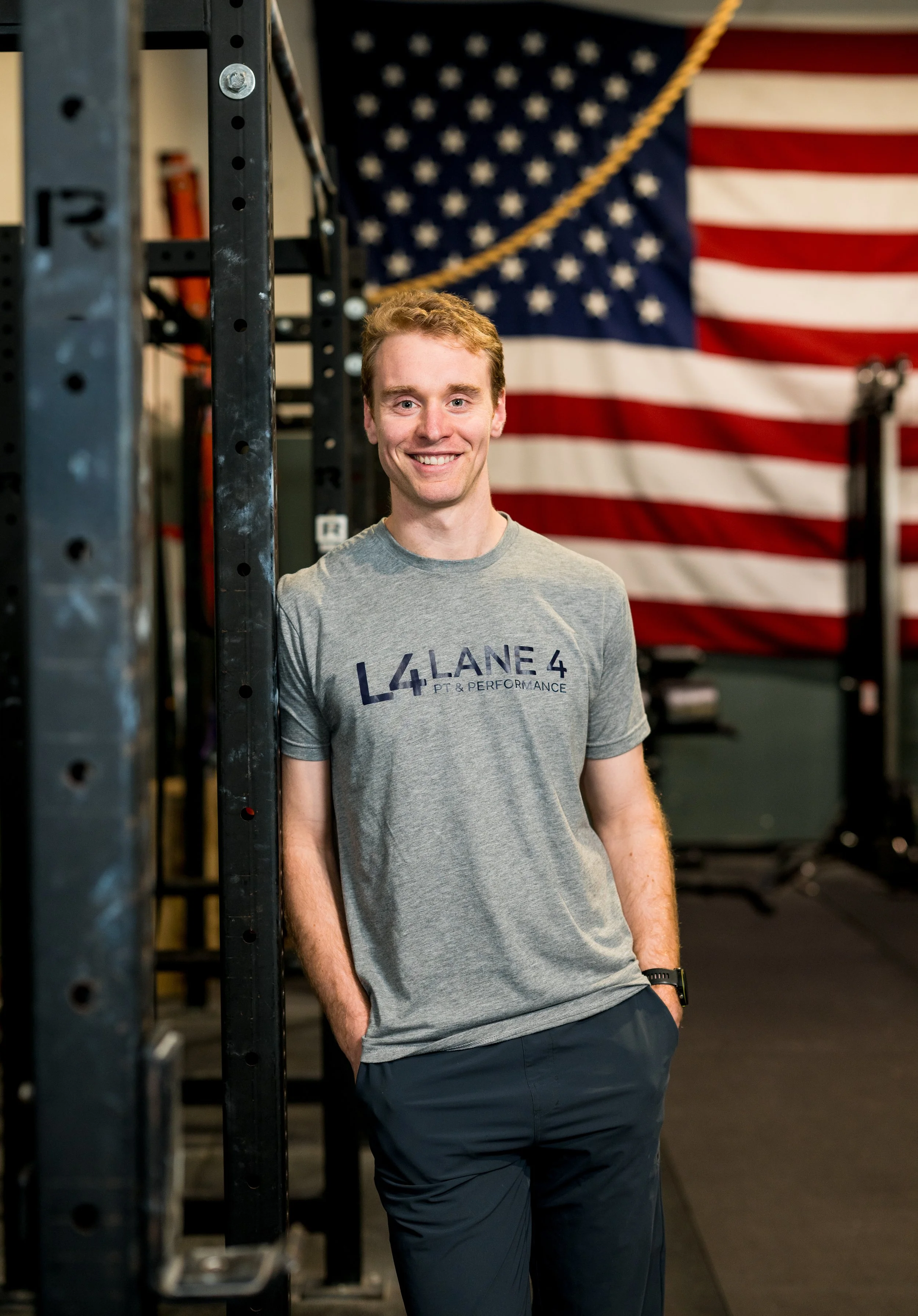
Alex is a Doctor of Physical Therapy and the founder of Lane 4 PT, based in Maryland, and The Swimming PT, which serves swimmers all over the country.
He swam at Boston University where he was a Division 1 butterflyer and captained the team his senior year. He is also an Ironman finisher.
His practice is one of the only ones I know of that is built specifically for swimmers and endurance athletes. It is a direct response to his own experience as an athlete who could not find real help when he needed it.
He is joining us at Beyond The Breakers for the first time in 2026.
From a Breakout Freshman Year to a Sophomore Slump
Alex's story is one that anyone who has competed at a high level will recognize immediately.
He had a breakout freshman year at BU. Then he went home to Maryland for the summer and grinded away with a local college team that allowed visiting D1 athletes to train with them. Somewhere in the middle of that summer, he started noticing his arm felt crunchy and noticeably weaker. He could not pull the water on fly the way he used to.
He was 19. He did what most 19-year-olds do. He pushed through it.
"You don't really think much of it," he told me. "You're just kind of pushing right through."
Then came sophomore year. His first meet of the season was the 200 fly, which had been his best event. It was, in his words, the slowest he had swum in a very long time. That was the moment he knew something was wrong.
He worked with the athletic training room. It got a little better. Never really got right. He ended up switching to distance and the mile because fly was no longer viable. He described it as the worst season of his career by a mile.
That summer, his mom pushed him to see a PT. A neighbor with a strong reputation.
"It was mind-blowing," he said. "The whole experience was amazing. It was very individualized. Very customized. Very focused to me."
He made real progress. Then he went back to school, back to the athletic training room, and lost the individualized attention. He backslid.
That contrast is what pushed him into PT as a career. The difference between generic care and swim-specific, athlete-specific care. The difference between "here are three exercises to try" and "let's figure out what is actually happening in your stroke that is driving this pain."
Why Swim-Specific PT Is Different From General Sports PT
I asked Alex what actually separates what he does from a generalist. His answer had two parts, and they both matter.
The first is training and technique context. You cannot fix a swimmer's shoulder without understanding what they are doing in the water. What is their weekly volume? What do their stroke mechanics look like? What kind of events are they training for? A masters open water swimmer training for a 10K is a completely different case than a college sprinter, and both need different plans.
The second is knowing that the painful spot is often not the actual problem.
"Maybe your rotator cuff is the problem. But if you really think about when you're feeling it in your stroke, it might not actually be the rotator cuff. That might be the thing that's painful, but it might not be the thing driving the rotator cuff to become painful."
That last piece is what most swimmers miss and what most general sports PTs are not equipped to catch. If you do not know exactly which muscles are firing at each phase of the freestyle pull, you are guessing.
The Cup Analogy of Injury Causation
One of the things Alex said that I think every open water swimmer in this community needs to hear is that injury is almost never caused by a single thing.
He described it as a cup. Every training swim adds a little water to the cup. Your strength sessions add more. A stressful week at work adds more. Bad sleep adds more. Fighting off a cold adds more. If you keep pouring in without ever draining anything out, the cup overflows. That is your injury.
"I rarely think there's this simple thing. It might be you ramped up training, and that could totally be it. But it also could be that you did your normal ramp-up, and it just so happened that you were sick a couple weeks prior and pushed through, and that's what led you to not recover."
This framing hits hard for me because I have seen swimmers in our community blame the last thing that happened before the injury showed up. The paddle set. The long swim. The new interval structure. Sometimes that is the trigger. But it is rarely the actual cause.
Open Water Is a Different Injury Profile
Alex and I talked about how the injury patterns he sees in open water swimmers are different from what shows up in pool athletes.
The demands are different. Conditions are unpredictable. There is more variability. And then there is the mechanics piece that every open water swimmer knows in their neck and shoulders. Sighting.
Every time you lift your head to sight, you are loading your neck and upper back in a way that pool swimmers are not. Do that a few hundred times over a long swim, and things get locked up. When your upper back and neck get tight, your shoulders end up compensating, and now the shoulder is where the pain shows up even though the root cause is higher up.
He also pointed out that open water swimmers are dealing with back-to-back long swims on weekends, plus the fact that there are no walls to break up the effort. That changes the recovery equation in ways your program has to account for.
What You Can Actually Do in the Water When Something Hurts
One of the most practical parts of our conversation was when I asked Alex what he tells swimmers to actually do in the water when something starts hurting during a long swim.
I have been there. In the middle of Catalina. On an English Channel attempt. On a long solo in training swim. Something starts hurting, and you are trying to figure out what to do in real time so you can get to the end without making it worse.
Alex's answers were refreshingly specific. Try to keep your head more neutral when you sight. If you think you are already barely lifting, you might actually be lifting a little less than that, and that small amount can be enough to reduce the load. He also talked about breaking up long swims with intentional drill work. Every 25 minutes or so, do a specific drill for a few minutes to change the mechanics and relieve accumulated stress.
Little tools like that are what separate a swimmer who finishes a hard swim from a swimmer who has to pull out at hour four.
Swimming for Life, Not Just Your Next Race

Alex's session at Beyond The Breakers 2026 is going to focus on what you can do in and out of the water to keep your body in the best position for performance and for a long swimming life.
That framing matters. A lot of the content in our sport is focused on the next race. The next big swim. The next PR. Alex is asking a different question, and it is one I think this community needs to hear more of.
"For a lot of swimmers, performance matters. One hundred percent. But a lot of people want to keep swimming for a long time, and they want to keep doing these long swims for a long time. What can you do in and out of the pool to set yourself up to swim for a lifetime? That is what we are aiming for."
I asked him who this session is really for. His honest answer was everyone, but if I had to describe the person who will get the most out of it, it is the swimmer with the nagging shoulder they have been ignoring. The one who has tried a few things but nothing really stuck. The one who knows they are not going to stop swimming and wants to make sure they can keep doing what they love for another twenty or thirty years.
That is a big chunk of this community. Including me.
One Piece of Advice
At the end of every Going Long conversation, I ask each speaker for a single piece of advice they would give to open water swimmers. Here is Alex's:
"Think about yourself as a complete athlete. A lot of people just want to swim, and there are times of the year when you should just swim. But if you can start thinking about yourself as an athlete who is a specialist in open water, and treat yourself as one, you are setting yourself up for a lot of swimming to come."
His Session At Beyond The Breakers
Alex is going to be one of the standout new voices in the room at Beyond The Breakers 2026. If you have been ignoring a nagging injury, if you have tried physical therapy before and given up on it, or if you just want to keep swimming for another few decades without breaking down, his session is going to be worth your time.
You can connect with Alex before then at Lane 4 PT if you are local to Maryland, or The Swimming PT if you are anywhere else.
And you can join us for his session and everything else on the 2026 agenda at Bentley University in Waltham, Massachusetts, on November 14-15.