
Water Logged With Elaine Howley
Elaine Howley on Crew, Commitment, and the Night She Told Sarah Thomas to Stop Making Decisions in the Dark…
I have been involved in open water swimming long enough to know that the people on the boat don’t get nearly enough credit. We talk about the swimmers. We track the dots on the tracker. We share the finish line photos. But the people who hold everything together for 30 or 40 or 54 hours, the ones making real-time decisions in the dark while the swimmer is unraveling, those people are largely invisible.
Elaine Howley is not invisible. But she should probably be more well known than she is.
She’s a marathon swimmer and ice swimmer. She’s won the International Swimming Hall of Fame’s Buck Dawson Author’s Award twice — first in 2023, and again in 2026. She co-founded the Massachusetts Open Water Swimming Association. She founded Channel Support Services. She has been writing about this sport for more than fifteen years. And she was on the boat for every one of the 54 hours it took Sarah Thomas to become the first person in history to swim the English Channel four consecutive times without stopping.
I sat down with Elaine for an episode of Water Logged, our new interview series here at Beyond The Breakers. I expected a conversation about swimming. What I got was something closer to a masterclass in what it actually means to give yourself to a sport, and to the people in it.
Who is Elaine Howley?
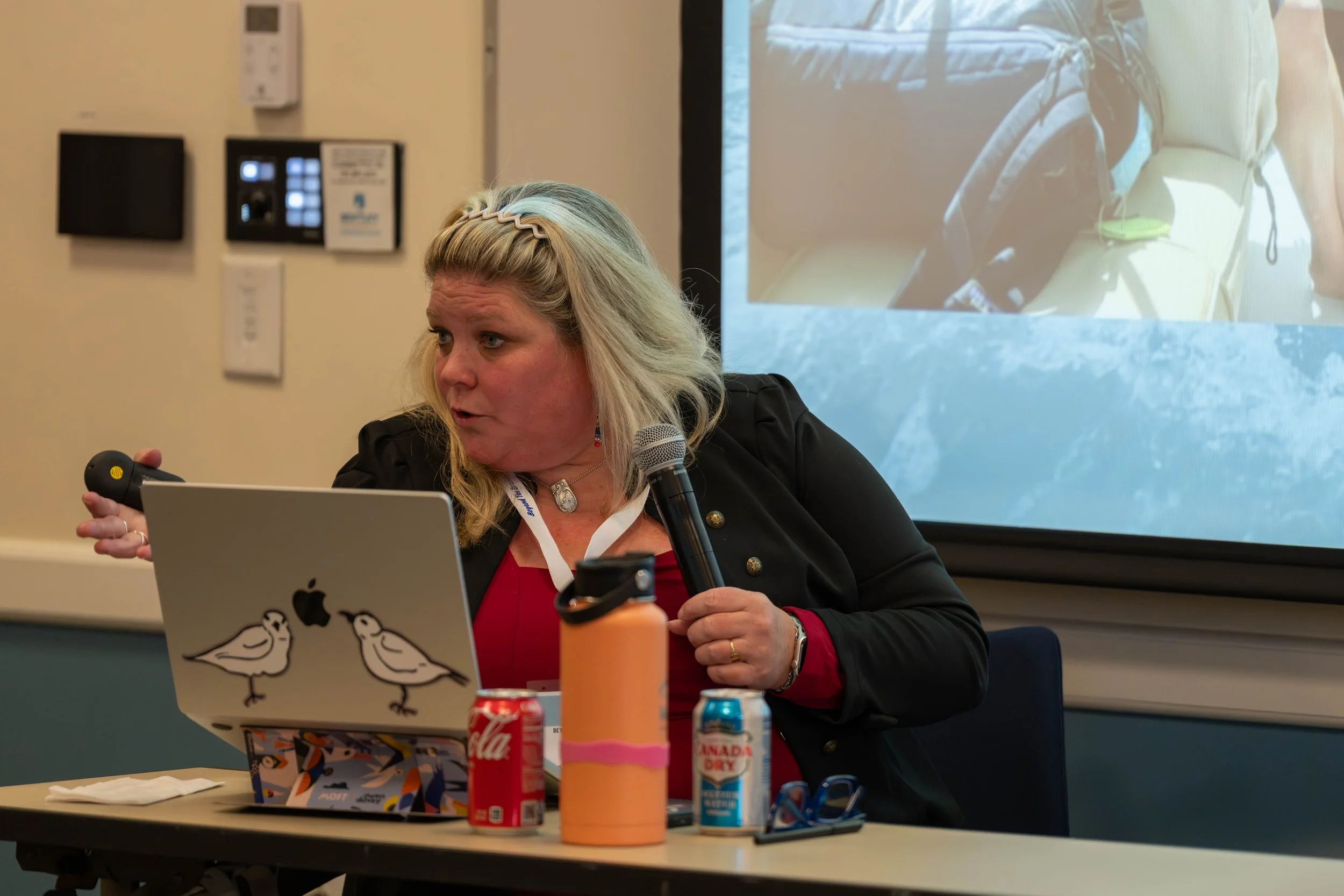
Photo Credit: Helen Cogan Photography
Elaine Kornbau Howley is an American marathon swimmer, ice swimmer, author, race director, and open water swimming organizer based in Waltham, Massachusetts. She completed the Triple Crown of Open Water Swimming in 2009, which includes solo swims across the English Channel, the Catalina Channel, and around Manhattan Island, becoming the 32nd person in history to do so.
She was the first person to swim the 32.3-mile length of Lake Pend Oreille in northern Idaho. She has also completed the Triple Crown of Lake Monster Swims, which includes Loch Ness, Lake Memphremagog, and Lake Tahoe. She is one of the 41 Ice Swimming Pioneers recognized for completing the inaugural winter swim at Lake Memphremagog in 2015 and she was inducted into the Vermont Open Water Swimming Hall of Fame in 2018.
She won the Buck Dawson Author’s Award from the International Swimming Hall of Fame in 2023 for her work as ghostwriter on Thomas Gompf’s memoir, “A Life Aloft.” She received the award a second time in 2026, as described in the interview.
She founded Channel Support Services and has supported more than 30 successful marathon and ice swims as crew, including serving on Sarah Thomas’ four-way English Channel crossing in 2019. She has also served as official observer on nearly 20 marathon and ice swims.
The Parallel Track
One of the things that struck me most in this conversation is how early Elaine understood something that takes most athletes years to realize: that a sport doesn’t survive on the ambitions of its participants alone. Someone has to show up and make the conditions possible for swimming to happen. And if you’re going to benefit from that infrastructure, you have to be willing to help build it.
"Marathon swimming can be a really selfish endeavor," she said. "You’re out there, you’ve got all these resources and people focused on you and your kind of arbitrary goal to go from point A to point B. It’s deeply meaningful, for sure. But a lot of that meaning comes from the team and who’s helping you. It became really clear to me very early on that unless I was willing to do that for other people, there wasn’t a path forward for me to continue swimming myself."
So she does both. Swimming and crewing and directing and writing and organizing, all in parallel. She started co-directing the Boston Light Swim around 2008. MOWSA grew from there. Channel Support Services came later. At no point did she treat these as separate careers. They’ve always been part of the same thing.
What It Feels Like to Be on the Boat
I asked Elaine what it’s actually like to crew someone through a major swim, to spend a full day or two days on a boat watching someone give everything they have, being the person responsible for keeping them together when they can’t do it themselves.
"First off, it’s a privilege," she said. "To be able to support somebody on something that is this important to them and meaningful."
But she was equally honest about the other dimension of it, the real-time problem-solving, the improvisation, the constant pressure of managing things that go wrong in environments where the options are limited.
"When I’m crewing, there’s a real element of you have to be thinking in real time. Something goes sideways and you have to figure out — the clip failed and we lost a water bottle, how are we going to adapt? The swimmer needs an Advil but we don’t have a proper pill delivery system. What am I going to MacGyver from the things I have on board? There are hundreds of little things that come up."
She brings a kit bag on every swim. She knows what’s in it. She’s solved most of the problems before. That institutional knowledge, the methodical problem-solving in the middle of conditions that would rattle most people, is what makes a great crew member.
The hardest Call
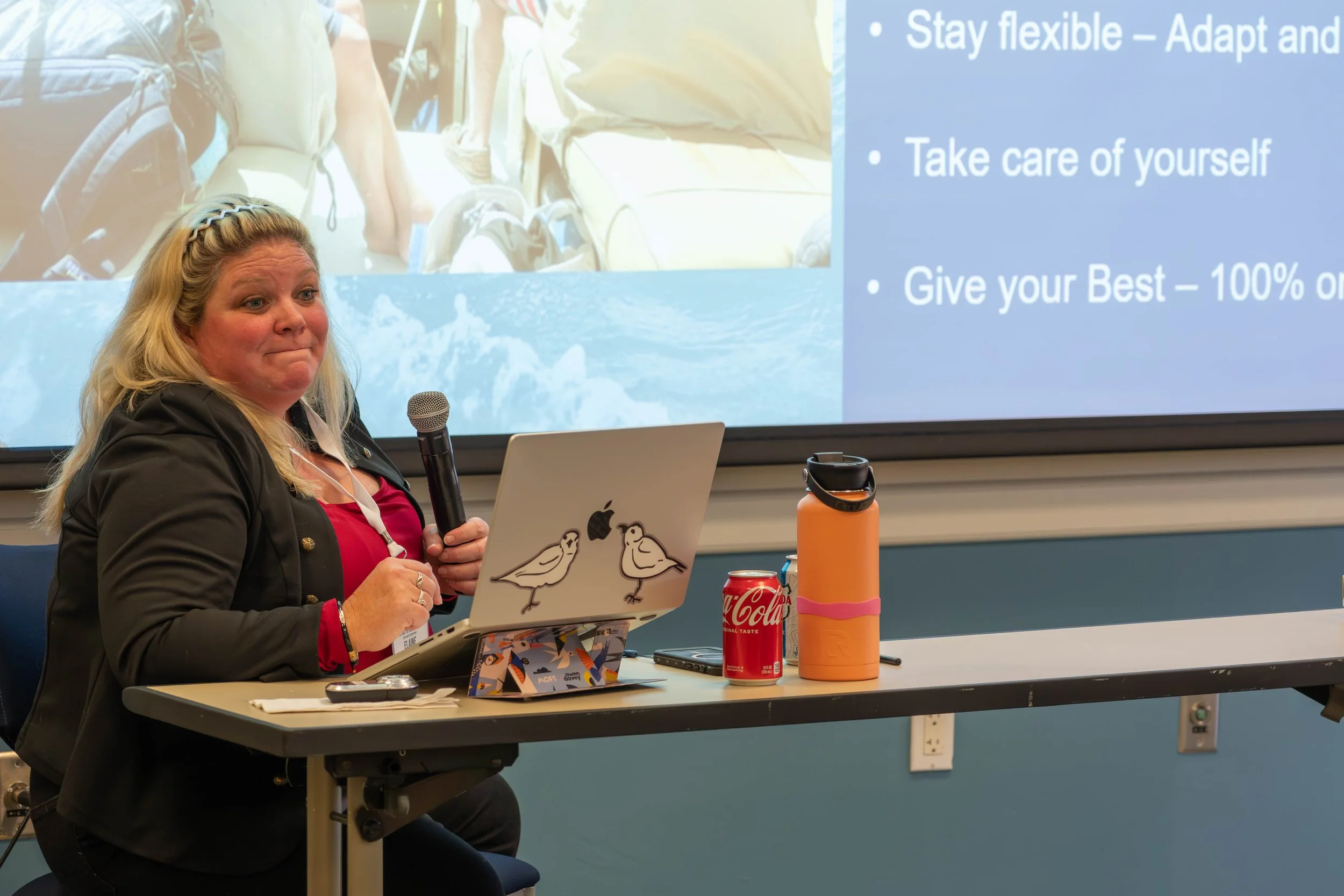
Photo Credit: Helen Cogan Photography
There is a side to crewing that most people never see. Sometimes the job isn’t to keep the swimmer going. Sometimes the job is to tell them it’s over.
Elaine described crewing a swimmer on an English Channel attempt. They were less than two miles off the coast of France and the swimmer had been in the water for eleven hours. The tide was turning and the pilot didn’t like the way things looked. This swimmer hadn’t been keeping down enough nutrition and Elaine was concerned about the cold.
"Having to deliver that news to her was one of the hardest things I’ve ever had to do in a swimming context," Elaine said. "Watching her comprehend it — it took a second for it to sink in. She handled it with such grace. She was cheerful and she understood, and yet I could see that her heart was breaking in that minute."
The swimmer came back and completed the crossing on a subsequent attempt. Elaine was there for that one too.
"That’s what it’s about," Elaine said. "The perseverance. Applying the lessons we learned on the failed attempt to make the next one successful."
It’s a story about what the relationship between a swimmer and a great crew member actually looks like when it works the way it is supposed to.
54 Hours in the English Channel
We couldn’t not talk about Sarah Thomas.
In September 2019, Sarah Thomas became the first person in history to swim the English Channel four consecutive times without stopping, completing a crossing of approximately 84 miles. Elaine was on the boat for the entire thing as crew, support swimmer at each turn, and managing what turned out to be a global media storm.
The story Elaine told me is not the one that made the news. It’s the one from midnight at the seawall above Shakespeare Beach.
Sarah had been swimming for 24 hours. She’d been seasick through most of the first two legs. The conditions on the night of the third turn were so favorable that the entire Channel fleet had come out, which meant their pilot had to navigate through an armada of boats in complete darkness to reach the turning point. Because of the traffic, Sarah couldn’t land on a beach. She had to touch the seawall and keep going.
"She’d been fantasizing about getting out of the water for a hot second, feeling gravity again, sitting down, stretching out, and then getting back in," Elaine told me. "But then we threw this curveball. You’re going to land at the seawall. Just touch."
Sarah was in the water at that point. Elaine was in the water with her, bringing food and supplies. When Sarah understood what was being asked of her, Elaine heard something she said she’d never quite heard before or since.
"She just sounded so heartbroken. Just anguish. She said, ‘I’m devastated’ — in her cute little West Texas accent. And I was like, oh god. This is terrible. But this is how it’s got to be."
"We don’t make decisions in the dark. You’ve got to stay in for six hours until sunrise. Then we can talk about if you want to get out. But you’re making the turn into the third leg and you’re just going to suck it up because that’s what we’re here to do." -Elaine Howley
Sarah made the turn. The sun came up six hours later. Her nausea finally responded to medication and she settled in to the third leg.
By the time Elaine got in for the fourth turn, Sarah looked at her and said: “Oh god, now I’ve got to swim all the way back. Whose idea was this?”
Meanwhile, somewhere during legs two and three, Elaine and a UK journalist named Suzanne Martin who was observing the swim had written a press release together on the boat and put it out on the wire. Elaine’s phone started ringing. She was fielding calls from media outlets between support swims, telling reporters she’d call them back in an hour and a half because she had to get in the water.
The fourth leg dragged on for approximately 17 hours. The tides didn’t cooperate and Sarah nearly ended up in the ferry terminal. The pilot had to make a hard turn into the current at the last hour, which meant Sarah had to sprint for the finish. She’d been swimming for over 50 hours.
"She’s just so gritty, so tough. She made it look easy."
— Elaine Howley
When they landed, the British press descended. Sarah needed a bath and a nap. Elaine had been awake for approximately 65 hours. They triaged interview requests from a house in Dover.
"It was a joyful fist in the face of reality," Elaine said. "Yeah, cancer — you didn’t get this one. You tried and you didn’t. And, oh by the way, she’s still the best in the world."
What She’s Bringing to Beyond The Breakers 2026
Elaine is returning to Beyond The Breakers this November for her third year and she is part of two sessions.
The first is the MOWSA Open Water Safety Panel, a frank, practical conversation about what it takes to keep swimmers safe, races accountable, and this sport sustainable. She was direct about why it matters.
"The best way to kill a swim is to kill a swimmer during the swim. Swimmers in has to equal swimmers out. Otherwise it’s game over. This is not a risk-free endeavor. But there are ways to make it a little bit safer. There are common sense things you can do that will protect people. So let’s be methodical about applying them."
The second session is a fireside chat with Sarah Thomas to close out the day. The theme is being the first — what it actually takes to attempt something that has never been done before, from both sides of the water. Elaine will draw on her own firsts as a swimmer and on her experience crewing swims into completely unmapped territory.
"If you are guaranteed to get there, what would be the point in starting?" she said. "Push the boundaries, push the limits, see how it goes. And if it doesn’t work the first time — what did you learn that you can apply to the second attempt?"
What She Said About BTB
Elaine has been at Beyond The Breakers for two years. I asked her what keeps bringing her back.
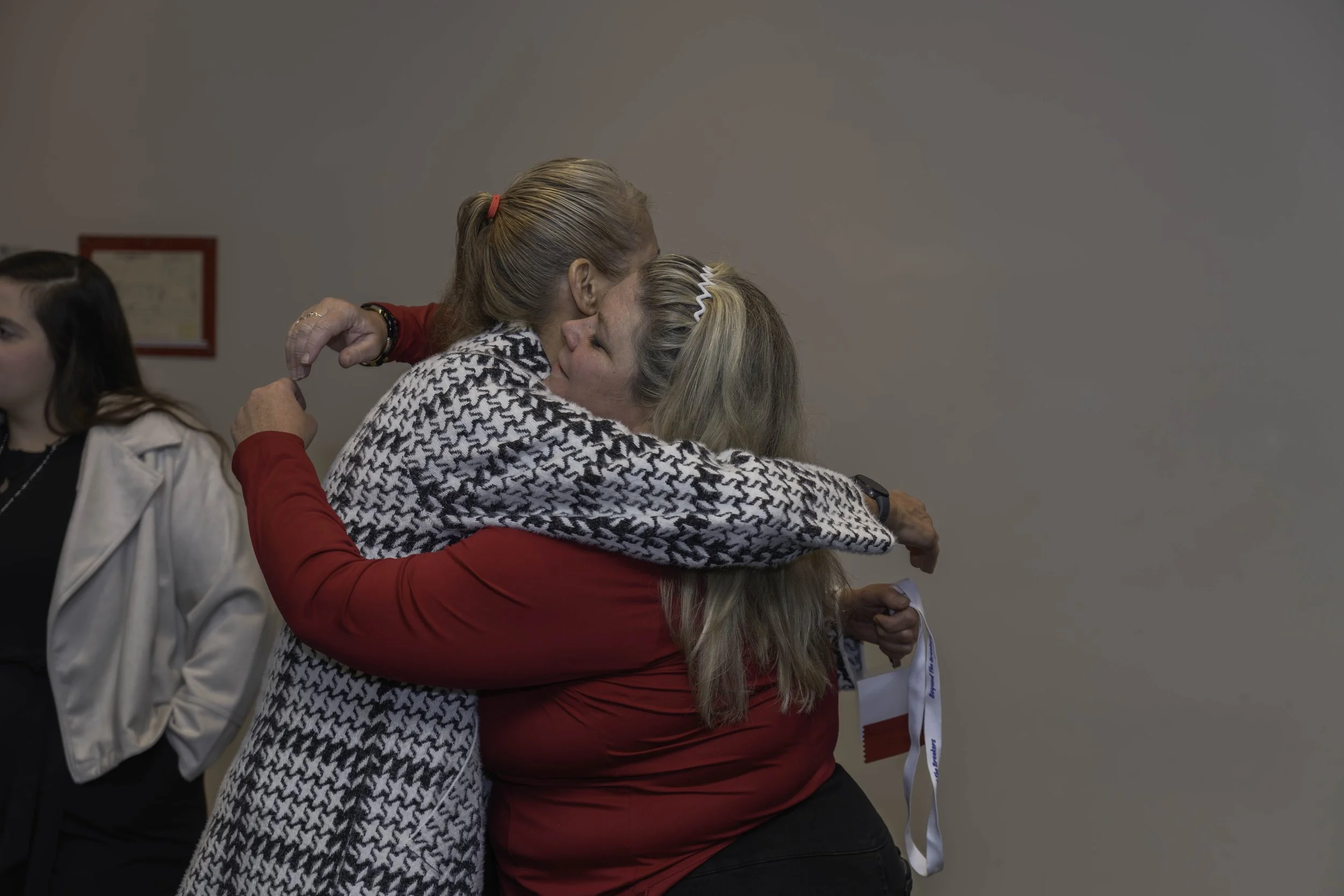
Photo Credit: Helen Cogan Photography
"It’s just been so fun to have so many swimmers all in one place in this context of an educational setting that’s also fun and social. The sessions have all been excellent. I don’t think I’ve sat through a single one that I thought was poor. I love that everybody is bringing themselves to the sport and to the community in a way that we don’t get to do in an event-based situation."
She mentioned a moment last year when someone came up after her session and asked her to sign their book of famous open water swimmers’ signatures. She was genuinely surprised and genuinely touched.
"Sometimes it’s those little unexpected interactions with people you’ve admired from afar that’s where the real value comes from."
She also said something that has stayed with me since.
"I think you’ve done a fabulous job creating this body of knowledge that hopefully is going to just continue for a long time."
I’ll take it. And I’ll take whatever it means that Elaine Howley — who has been at the center of this sport as a swimmer, a crew member, a writer, an organizer, and a race director for nearly two decades — keeps coming back.